

Silverado 2500 Towing Capacity: Haul with Confidence in Texas

Silverado 2500 Towing Capacity: The Silverado 2500 delivers exceptional towing capability with conventional hitch ratings spanning roughly 14,500 to 20,000 pounds, while properly equipped gooseneck or fifth-wheel setups reach up to 22,500 pounds. The 2025 Silverado payload specs fall in the 3,850–3,979 lb range, ensuring you have the capacity for both bed loads and trailer tongue weight.
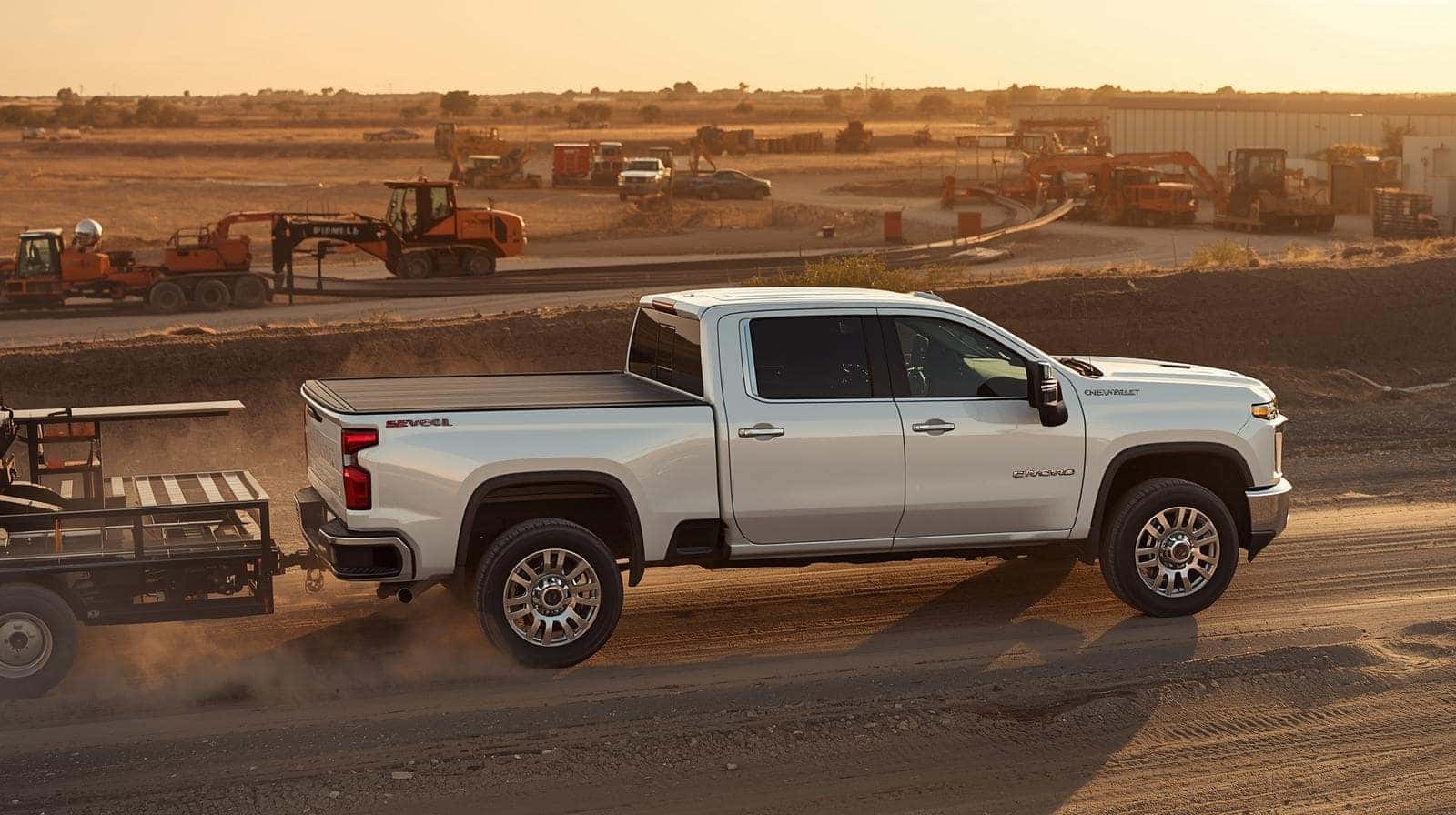
The Silverado 2500 is built for heavy-duty work—pulling equipment across Houston job sites or towing livestock trailers around Galveston County. It’s engineered to handle demanding loads so you can focus on the job, not the truck.
At Ron Carter Chevy in Alvin, we match Southeast Texas drivers with the right truck, configuration, and trailering equipment for their real-world needs.
Real-world numbers you can use: conventional hitch ratings span roughly 14,500 to 20,000 pounds, while properly equipped gooseneck or fifth-wheel setups reach up to 22,500 pounds. The 2025 Silverado payload specs fall in the 3,850–3,979 lb range—so plan bed loads accordingly.
Engine choices matter: a 6.6L V8 gas option and a 6.6L Duramax turbo-diesel deliver different balance of cost, power, and efficiency. Pick the powertrain that matches how often and how heavy you tow.
Key Takeaways
- Maximum fifth-wheel/gooseneck capacity: up to 22,500 lbs with the proper configuration
- Conventional towing: typically 14,500–20,000 lbs depending on setup and axle ratio
- Payload (2025): about 3,850–3,979 lbs—factor this into trailer tongue weight and cargo
- Engine options (gas vs. diesel) change towing, fuel economy, and day-to-day drivability
- For practical advice and a demo, bring trailer specs to Ron Carter Chevy so we can verify exact capacity for your chosen cab, bed, and hitch
Why the Silverado 2500 Is Built for Texas Hauling
When hauling across Southeast Texas you need a truck that matches the scale and intensity of the work. The Silverado 2500 towing capacity and heavy-duty construction deliver the performance Texas drivers expect—whether you’re pulling construction equipment through Houston or moving livestock trailers around Galveston County. At Ron Carter Chevy, we help local owners choose the right 2500 for their specific jobs.
Our Alvin location at 3205 FM 528 Rd serves contractors, ranchers, commercial fleets, and recreational towers. Different jobs require different setups, but everyone needs a truck they can rely on under tough conditions.
The Unique Demands of Texas Roads and Work Sites
- Heat & long runs: Sustained highway pulls and summer temperatures above 100°F stress cooling systems, transmissions, and engines—so upgraded cooling matters.
- Coastal corrosion: Salt air near Galveston accelerates corrosion; corrosion-resistant components and protective coatings lengthen service life.
- Varying terrain: From rough construction sites to county roads, reinforced frames and heavy-duty suspension keep trailers stable and safe.
- Fuel economy on long hauls: Advanced powertrains balance capability and efficiency so you spend less time refueling on long Texas drives.
What Sets the 2500 Apart from Light-Duty Trucks
The difference goes beyond advertised numbers. While the Silverado 1500 handles many tasks, the 2500 is engineered for serious hauling—higher towing and payload reserves, stronger frame components, and heavy-duty cooling and brakes.
Quick differences at a glance:
| Feature | Silverado 1500 (Light-Duty) | Silverado 2500 HD (Heavy-Duty) | Key Advantage |
|---|---|---|---|
| Maximum Towing (typical) | ~13,300 lbs | Up to ~22,500 lbs | Much higher maximum towing for heavy trailers |
| Frame | Fully boxed frame | Reinforced fully boxed frame | Stronger under sustained load |
| Suspension | Standard-duty components | Heavy-duty upgraded components | Better stability when towing |
| Cooling | Standard cooling | Enhanced radiators & transmission coolers | Maintains temps on long, hot pulls |
Practical Examples
- Houston contractor: Hauling a 20-ft equipment trailer plus tools—choose a 2500 with diesel or higher axle ratio for confident acceleration and braking.
- Galveston rancher: Towing a gooseneck livestock trailer—select a reinforced frame 2500 with gooseneck prep for stability and reduced sway.
Understanding Chevy truck payload ratings is essential: payload is what you can carry in the bed and directly affects how much trailer weight you can tow safely. The 2500’s higher payload and towing reserves mean less wear, better safety, and longer component life when you run heavy loads regularly.
See configurations and compare options in person—visit our Alvin showroom to review cab, bed, engine, and axle choices that match your equipment and job requirements.
Understanding Silverado 2500 Towing Capacity Specifications
Towing capacity isn’t a single fixed number for the Silverado 2500—it depends on your truck’s cab, bed, engine, axle ratio, and the towing method you use. At Ron Carter Chevy we help drivers decode those numbers so they can tow confidently and safely.
Use the short checklist below before you tow: photograph the door-jamb weight label, confirm trailer GVWR, verify hitch/tongue ratings, and calculate GCWR math (truck curb weight + cargo + trailer = total).
Maximum Conventional Towing Numbers Explained
Conventional towing uses a rear-mounted ball hitch and is common for boat trailers and smaller hauls. Depending on equipment and axle ratio, the Silverado 2500 can be rated for conventional towing up to roughly 20,000 pounds. Cab and bed choices affect this—Regular Cab/long bed combos usually yield higher ratings than Crew Cab/short bed setups.
Engine choice matters too: the 6.6L V8 gasoline engine (about 401 hp / 464 lb-ft) covers many towing needs and pairs with axle options to reach strong conventional towing numbers without the diesel’s added cost.
Fifth-Wheel and Gooseneck Towing Capabilities
Fifth-wheel and gooseneck hitches transfer trailer weight over the truck’s rear axle for better stability. When properly equipped, the Silverado 2500’s fifth-wheel/gooseneck ratings range approximately from 18,500 to 22,500 pounds, making it suitable for large RVs and heavy equipment trailers.
The Duramax 6.6L turbo-diesel (noted for its high torque) is often the preferred choice for heavy fifth-wheel/gooseneck work because it helps maintain speed on grades and reduce transmission load.
How Towing Capacity Is Calculated (Short Steps)
- Find your truck’s GVWR and GAWR on the driver’s door jamb sticker.
- Identify your truck curb weight (or empty weight) and add passengers, fuel, and cargo to get truck weight.
- Subtract truck weight from GCWR to determine the maximum trailer weight you can legally and safely tow.
- Always ensure hitch and axle ratings meet or exceed your planned trailer tongue load.
Understanding Your Vehicle’s Specific Ratings
Every Silverado 2500 has a unique sticker showing GVWR, GAWR, and seating limits—these specific numbers override generic max figures you see online. A diesel Crew Cab short-bed will have different ratings than a gas Regular Cab long-bed even though both are “Silverado 2500” trucks.
Bring a photo of your door-jamb label and your trailer specification sheet to our showroom; we’ll verify exact towing capacity and recommend the right axle ratio, hitch, and configuration for your planned loads.
Engine Options and Their Impact on Towing Performance
Your engine choice determines how the Silverado 2500 performs under load—affecting acceleration with a trailer, hill-climbing ability, fuel costs, and the truck’s practical towing capacity. We work with Texas drivers to match engine choice to real-world towing needs, not just peak numbers.
The Silverado 2500 offers two primary powertrains. Each suits different towing frequencies, trailer weights, and budgets—so pick the one that fits your routine hauling.
6.6L V8 Gasoline Engine Towing Ratings
The 6.6L V8 gas engine is a solid, lower-cost choice for owners who tow regularly but rarely push to absolute maximum ratings. It provides dependable power and simpler maintenance compared with diesel alternatives—good for contractors and weekend towers who want capability without diesel ownership costs.
Typical spec highlights for the gas V8 include about 401 horsepower and 464 lb-ft of torque. When properly equipped this engine supports strong conventional towing numbers and serves well for mid-range fifth-wheel loads.
| Engine Specification | 6.6L V8 Gasoline | 6.6L Duramax Diesel |
|---|---|---|
| Horsepower | 401 hp | 470 hp |
| Torque | 464 lb-ft | 975 lb-ft |
| Max Conventional Towing | ~14,500 lbs | ~18,500 lbs |
| Max Fifth-Wheel/Gooseneck | ~18,000 lbs | ~22,500 lbs |
Best Applications for the Gas Engine
- Occasional towing of mid-size trailers or equipment.
- Contractors who carry heavy bed loads but only tow a few times a week.
- Buyers prioritizing lower upfront cost and simpler maintenance.
Duramax 6.6L Turbo-Diesel Towing Advantages
The Duramax 6.6L turbo-diesel is built for frequent heavy towing. Its strength is torque—useful for getting heavy trailers moving and holding speed on long grades—making it the go-to choice for owners who regularly tow near the truck’s maximum capacity.
Maximum Torque for Heavy Loads
The Duramax delivers roughly 470 hp and 975 lb-ft of torque, paired with the Allison 10-speed automatic transmission for smooth, durable power delivery. Together this combination enables the highest Silverado 2500 towing capacity figures—especially for fifth-wheel and gooseneck setups.
“For drivers who tow heavy loads regularly, diesel’s torque and towing efficiency often outweigh the higher initial cost.”
Fuel Efficiency While Towing
Diesel powertrains typically return better mpg when towing heavy loads—often by a few mpg in long-haul scenarios—so consider annual towing miles when evaluating payback versus higher purchase price.
Which Powertrain Should You Choose?
- Choose gas if you tow under ~12,000 lbs regularly, want lower purchase and maintenance costs, and value simpler servicing.
- Choose Duramax diesel if you tow frequently, haul loads over ~15,000 lbs, or need maximum fifth-wheel/gooseneck capability and sustained hill performance.
Quick Examples
- Example 1 — Contractor: Hauling a 20-ft equipment trailer (10,000–14,000 lbs) plus tools—gas V8 with a towing package is often sufficient.
- Example 2 — Full-time tower: Towing a 30-ft fifth-wheel RV or heavy equipment trailer (15,000–22,500 lbs)—Duramax diesel with proper axle ratio is recommended.
Schedule an engine-comparison test drive at Ron Carter Chevy so you can feel the difference and see how each powertrain handles your typical loads.
How Cab and Bed Configurations Affect Towing Capacity
Choosing cab, bed, and trim affects the Silverado 2500’s weight distribution, payload, and real-world towing performance. Small configuration changes change what you can safely carry in the bed and tow behind the truck—so match the setup to your routine loads.
Quick pick: Commercial users who prioritize maximum capability usually choose Regular Cab + lighter trim; crews and families typically prefer Crew Cab for seating and comfort with only a small tradeoff in capacity.
Cab Style: Regular, Double, Crew — Pros and Cons
- Regular Cab — Lightest curb weight, highest payload and towing ratings; best for single-operator fleets and buyers who need maximum capability.
- Double Cab — Middle ground: extra rear seating with a modest weight penalty; useful for small crews that casionally ride together.
- Crew Cab — Full four-door convenience and passenger comfort; slightly lower max ratings but better daily usability for families and crews.
Standard Bed vs Long Bed
- Standard 6.6-ft bed — Easier maneuvering and garage fit; good for general purpose hauling and weekend tasks.
- 8-ft long bed — Needed for full sheets of plywood, longer equipment, and improved weight distribution with fifth-wheel/gooseneck trailers; longer wheelbase increases towing stability on highways.
Trim and Options: How Features Change Capacity
Higher trims and added options increase curb weight, which reduces payload. The WT (Work Truck) trim keeps equipment light and payload high—ideal for fleet use—while LT/LTZ and High Country add comforts that slightly lower payload but improve daily comfort.
WT (Work Truck)
- Focus: maximum capability with minimal frills
- Benefits: lighter curb weight, higher payload (around the 3,850–3,979 lb range on builder configurations)
LT / LTZ / High Country
- Focus: comfort and tech—adds leather, infotainment, and safety features
- Impact: modest payload reduction but maintained towing capability for most users
Short Checklist: Pick the Right Configuration
- If you regularly haul long materials (e.g., full sheets of plywood or long equipment), choose a long bed.
- If you tow heavy fifth-wheel or gooseneck trailers, favor a long bed and the configuration with the highest payload rating.
- If you carry passengers daily and tow occasionally, a Crew Cab balances comfort and capability.
- Bring your typical load dimensions and weights to the showroom—our team will match a cab/bed/trim combination to your real needs.
| Configuration | Best For | Typical Payload | Key Advantage |
|---|---|---|---|
| Regular Cab, Standard Bed | Fleets, max capability | ~3,950–3,979 lbs | Lightest weight, highest payload |
| Double Cab, Standard Bed | Small crews | ~3,900–3,940 lbs | Balance of passenger access and capacity |
| Crew Cab, Standard Bed | Family hauling, daily use | ~3,850–3,900 lbs | Passenger comfort with strong capability |
| Crew Cab, Long Bed | Fifth-wheel towing, long cargo | ~3,850–3,890 lbs | Best stability for heavy trailers |
Real-World Towing Scenarios Across Texas
Numbers matter, but real jobs tell the story. Southeast Texas drivers push their trucks through long highway runs, dusty job sites, and coastal conditions—so we match each Silverado 2500 to the work it will do. Below are common scenarios and the spec choices we recommend.
1) Hauling Construction Equipment and Building Materials
Construction crews in Greater Houston often tow equipment and also carry tools and supplies in the bed. The 2500 is built for this mixed workload.
- Recommended spec: 6.6L V8 gas or diesel with tow package, Regular or Double Cab depending on crew needs, hitch-rated for your trailer
- Why it works: Upgraded cooling, heavy-duty suspension, and integrated trailer brake controller help with stop-and-go traffic and heavy loads.
- Example: Hauling a 20-ft equipment trailer (10,000–14,000 lbs) plus tools—gas V8 with correct axle ratio usually performs well.
2) Towing Livestock and Horse Trailers
Ranchers need steady, stable towing for moving animals—safety and reduced sway are top priorities.
- Recommended spec: Gooseneck or fifth-wheel prep, Duramax diesel (if you tow heavy or frequently), reinforced frame and Trailer Sway Control enabled
- Why it works: Gooseneck weight distribution, sway mitigation systems, and strong torque help maintain stability and comfort for animals.
- Example: A gooseneck livestock trailer regularly loaded with animals—choose a configuration optimized for tongue weight and long-distance drives.
3) Recreational Towing: RVs and Boat Trailers
Families towing large travel trailers or boats need confidence on long trips and at launch ramps.
- Recommended spec: Duramax diesel for heavy RVs, long-bed option for improved fifth-wheel stability, trailering app and Transparent Trailer View for easier lane changes
- Why it works: Diesel torque and Allison transmission maintain speed on grades and improve fuel economy on long hauls; Hill Start Assist helps at ramps.
- Example: Towing a 35-ft fifth-wheel RV — diesel with proper axle ratio and long bed provides best stability and comfort.
Handling Texas Heat, Humidity, and Steep Grades
- Cooling: Enhanced radiators and transmission coolers are essential for sustained highway towing in triple-digit temps.
- Accessories: Use the trailering app to monitor temperatures, brakes, and trailer status; set trailer profiles in the system.
- Braking: Auto Grade Braking and the integrated trailer brake controller reduce brake wear on long descents.
Quick Side-by-Side Spec Picks
| User | Engine | Bed/Cab | Hitch |
|---|---|---|---|
| Houston contractor | 6.6L V8 (or diesel if heavier loads) | Standard bed, Double Cab | Conventional or gooseneck as needed |
| Galveston rancher | Duramax diesel | Crew Cab, long bed | Gooseneck |
| Weekend RV family | Duramax diesel | Crew Cab, long bed | Fifth-wheel |
Bring your trailer specs (GVWR, tongue weight, dimensions) to Ron Carter Chevy and we’ll verify exact ratings for your specific Silverado 2500 configuration. Call (281) 824-3663 to schedule a demo or arrange a real-world towing test—bring your trailer when possible so you can see how the truck handles your equipment on Texas roads.
Comparing Silverado Payload Specs: 1500 vs 2500 Capabilities
Choosing between the Silverado 1500 and 2500 is about matching capability to your real needs—not buying more truck than you need or underspec’ing for the work ahead. We help customers at Ron Carter Chevy weigh payload, towing capacity, and day-to-day usability so they get the right truck for the job.
2025 Chevy 1500: Light-Duty Strengths
The Silverado 1500 is a capable half-ton truck designed for daily driving, better fuel economy, and lighter towing. Typical payload ranges are roughly 1,800–2,200 pounds, and conventional towing tops near 13,300 pounds depending on configuration.
Why Upgrade to the Silverado 2500 HD?
When you regularly tow heavy trailers, haul large payloads, or need commercial durability, the Silverado 2500 HD offers significantly more reserve. Payloads jump to roughly 3,850–3,979 pounds, and conventional towing capability can reach much higher—depending on engine, axle ratio, and hitch—making the 2500 the right choice for demanding work.
| Specification | Silverado 1500 | Silverado 2500 HD |
|---|---|---|
| Maximum Conventional Towing | ~13,300 lbs | Up to ~20,000 lbs |
| Fifth-Wheel/Gooseneck Towing | Not typical for half-ton | Up to ~22,500 lbs |
| Payload Capacity Range | ~1,800–2,200 lbs | ~3,850–3,979 lbs |
| Frame Construction | Fully-boxed steel | High-strength steel (stiffer for HD) |
Which to Pick — Quick Decision Guide
- Choose the 1500 if you tow occasionally, haul moderate loads, want better everyday fuel economy, and prefer a lighter, more car-like truck.
- Choose the 2500 if you tow frequently, plan to pull heavy fifth-wheel/gooseneck trailers, carry large payloads, or need a truck built for sustained commercial use.
Typical User Examples
- Landscaper: Regular bed loads, occasional utility trailer—1500 works unless you tow heavy equipment daily.
- Weekend RV owner: Mid-size travel trailer—1500 may suffice; larger fifth-wheel RVs point to a 2500.
- Heavy-equipment contractor: Daily hauling of heavy trailers and materials—2500 is the practical, long-term choice.
If you’re unsure which class fits your needs, bring trailer specs and sample payloads to Ron Carter Chevy. We’ll review your requirements and show configurations and features that give you the right balance of capability and comfort.
Advanced Towing Technology and Safety Features
Modern towing is as much about systems and safety as it is about raw capacity. The Silverado 2500 packs trailering features that make hooking up, driving, and stopping with a heavy load easier and safer—useful whether you’re new to towing or have years of experience.
Below are the key systems, a quick benefit line, and a practical tip for using each feature on the road.
Integrated Trailer Brake Controller System
- Benefit: Synchronizes truck and trailer braking for smoother, shorter stops.
- Tip: Set and save brake profiles for each trailer via the infotainment screen; test settings on a short run before highway speeds.
Trailer Sway Control & Stability Management
- Benefit: Detects oscillation early and applies corrective braking/throttle adjustments to recover stability.
- Tip: Keep load distribution balanced and let the system assist—if sway begins, gently reduce speed and avoid abrupt steering.
Advanced Camera Systems (Up to 14 Views)
- Benefit: Multiple angles give a fuller picture around truck and trailer for safer lane changes and backing.
- Tip: Use the Rear Hitch View to align your coupler and Transparent Trailer View (if equipped) for lane changes.
Transparent Trailer View Technology — Quick How-To
- Connect the trailer profile in the trailering app.
- Enable Transparent Trailer View before merging or lane changes.
- Use the digital “see-through” feed to confirm adjacent lane clearance before signaling.
Hitch Guidance & Trailer Alignment
- Benefit: Visual guidance and distance indicators make lining up ball, gooseneck, or fifth-wheel hitches fast and accurate.
- Tip: Use Hitch View at low speed with a spotter if available; the system saves trailer positions for repeat hitching.
Trailering App and Vehicle Integration
- Benefit: Centralizes pre-trip checklists, trailer profiles, maintenance reminders, and towing diagnostics in one place.
- Tip: Create a trailer profile with GVWR, tongue weight, and length; run the pre-departure checklist each time.
| Technology | Primary Function | Practical Benefit | Best Use |
|---|---|---|---|
| Integrated Trailer Brake Controller | Coordinates braking | Improved stopping control | Heavy loads & highway towing |
| Trailer Sway Control | Detects & corrects sway | Prevents loss of control | Crosswinds & passing trucks |
| Transparent Trailer View | See-through trailer visibility | Eliminates blind spots | Lane changes & backing |
| Hitch Guidance | Visual alignment | Faster, safer hitching | Connecting trailers solo |
| Trailering App | Profiles & checklists | Organized towing prep | Managing multiple trailers |
Other active safety aids—Forward Collision Alert, Automatic Emergency Braking, and Lane Departure Warning—adjust their behavior when towing, helping maintain safe distances and lane position with a trailer attached.
Tech checklist for first-time towers: enable your trailer profile, set trailer length, test trailer brakes at low speed, and save settings for future use. Want a hands-on demo of Transparent Trailer View, Hitch Guidance, or the trailering app? Schedule a test at Ron Carter Chevy and we’ll walk you through each feature with a trailer on site.
Experience the Silverado 2500 at Ron Carter Chevy in Alvin
Start your search at Ron Carter Chevy in Alvin to compare Silverado 2500 configurations side-by-side and see towing specs in person. Visit us at 3205 FM 528 Rd to review real trucks, ask detailed questions, and get a tailored recommendation based on your trailer and payload.
Our Selection of Heavy-Duty Silverado Trucks
We stock a wide range of Silverado 2500s—from the work-focused Regular Cab WT to Crew Cab LT/LTZ and the luxury High Country. Choose between the 6.6L V8 gasoline and the 6.6L Duramax turbo-diesel, plus multiple bed lengths and axle ratios to match your towing needs.
Expert Guidance on Configuration
Our sales team asks about your typical loads, towing frequency, trailer type, and daily use so we can recommend the right cab, bed, engine, and hitch. We focus on practical fit—matching truck capability to your real job or recreational needs, not just the highest numbers.
Test Drives and Towing Demonstrations
Driving a Silverado 2500 is the best way to judge power delivery, handling, and tow tech. We offer test drives that let you feel the Duramax torque, Allison transmission shifts, and camera/hitch guidance systems. When possible, bring your trailer—bringing GVWR, tongue weight, and dimensions lets us set up a real-world towing demo so you can see how the truck performs with your equipment.
| Configuration Type | Best Applications | Key Advantages | Typical Towing Range |
|---|---|---|---|
| Regular Cab WT (Gas) | Commercial fleets, work trucks | Lower purchase price, higher payload | ~14,500 – 16,800 lbs |
| Crew Cab LT (Gas) | Family hauling, crew transport | Passenger comfort with capability | ~13,000 – 15,400 lbs |
| Crew Cab LTZ (Diesel) | Heavy RVs, frequent towing | High torque, better towing economy | ~18,500 – 20,000 lbs |
| Crew Cab High Country (Diesel) | Luxury towing, premium use | Top comfort with strong towing | ~18,000 – 20,000 lbs |
Convenient Location and Support
We’re located at 3205 FM 528 Rd, Alvin, TX 77511, serving Houston, Pearland, League City, Texas City, Galveston, and surrounding areas. Call (281) 824-3663 to schedule a test drive or towing demo. For the most useful visit, bring your trailer specs (GVWR, tongue weight, length) and any questions about hitch type or payload.
Beyond sales, our service and parts departments support long-term ownership—routine maintenance, towing-related repairs, and OEM parts keep your Silverado 2500 performing at its best. Schedule a consult or test drive online or by phone and we’ll prepare a demonstration tailored to your needs.
Conclusion
The Silverado 2500 towing capacity delivers the muscle and durability many Texas drivers need—configurations properly equipped for fifth-wheel/gooseneck towing reach up to 22,500 pounds, while conventional hitch ratings vary by setup. More than headline numbers, the 2500 provides the frame, cooling, and towing systems to handle sustained heavy work.
Choosing the right combination of engine, cab, bed, and trim determines real-world capability: a gas 6.6L V8 balances cost and capability for moderate towing, while the Duramax diesel offers maximum torque and efficiency for frequent heavy loads. Trim and options add comfort but will reduce payload slightly, so match features to your priorities.
Want a clear recommendation for your needs? Bring your trailer specs (GVWR, tongue weight, length) and a photo of your truck’s door-jamb sticker to Ron Carter Chevy. Our team will verify exact ratings, show configurations, and arrange a test drive or towing demo so you can see how a specific Silverado 2500 performs with your equipment.
FAQ
What is the maximum towing capacity of the 2025 Silverado 2500?
Depending on engine, axle ratio, hitch and options, the 2025 Silverado 2500 can tow up to around 20,000 lbs conventionally and up to about 22,500 lbs with properly equipped fifth-wheel or gooseneck setups. Exact numbers depend on your truck’s specific configuration—check the door-jamb sticker or bring it to us for verification.
How do I find the exact towing capacity for my truck?
Step 1: Photograph the driver’s door-jamb sticker (shows GVWR, GAWR). Step 2: Note your engine, cab, bed, axle ratio, and hitch type. Step 3: Use GCWR math (truck + cargo + trailer) or bring these details to Ron Carter Chevy—our experts will confirm exact capacity and recommend axle/hitch changes if needed.
Should I choose gas or diesel for towing in Texas?
Choose gas (6.6L V8) if you tow occasionally and want lower purchase and maintenance costs; it’s suitable for many loads under ~12,000 lbs. Choose the Duramax diesel if you tow frequently, haul heavier loads (15,000+ lbs), or want better long-haul fuel economy and hill performance.
Where can I test drive and get answers in Alvin?
Visit Ron Carter Chevy at 3205 FM 528 Rd, Alvin, TX, or call (281) 824-3663 to schedule a test drive or towing demo. Bring trailer specs and your door-jamb photo for the most accurate, personalized guidance.
0 comment(s) so far on Silverado 2500 Towing Capacity: Haul with Confidence in Texas